July 1999
Modern vs. Classical Developers
by Brian Dunning
digg this article | del.icio.us this article
 It
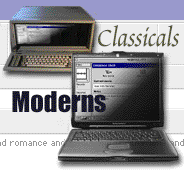
has been observed that there are generally two types of FileMaker
Pro developers, the Moderns and the Classicals. You’ve seen
both, wandering around the conferences, some with the latest G3
PowerBooks, and some with suitcase-sized 1983 Compaqs. Modern
developers take advantage of every newfangled thing that comes
down the pipe, be it hardware, software, firmware, flexware, grayware,
or any other type of yuppieware the wordsmiths can invent. Classical
developers are more reserved, preferring to stick to the tried
& true, and avoiding anything perceived as glitzy and unnecessary.
Example: the modern developer uses Status(CurrentDate), and the
classical developer uses the Today function.
It
has been observed that there are generally two types of FileMaker
Pro developers, the Moderns and the Classicals. You’ve seen
both, wandering around the conferences, some with the latest G3
PowerBooks, and some with suitcase-sized 1983 Compaqs. Modern
developers take advantage of every newfangled thing that comes
down the pipe, be it hardware, software, firmware, flexware, grayware,
or any other type of yuppieware the wordsmiths can invent. Classical
developers are more reserved, preferring to stick to the tried
& true, and avoiding anything perceived as glitzy and unnecessary.
Example: the modern developer uses Status(CurrentDate), and the
classical developer uses the Today function.
It’s neither right nor wrong to be modern or classical. Most of us lean pretty heavily toward one end of the spectrum or the other. If you are unsure where you score in this arena, read on and see how many of the following apply to you.
The modern developer joined the FileMaker Solutions Alliance primarily for access to the newest betas, and does all of his development in a version of FileMaker Pro that mortals have not yet theorized about. The classical developer does everything in 2.1, because some clients out there may still be using it, and it would be unwise to deliver a solution that they may not be able to use. By the same token, the modern developer aggressively lobbies his clientele to purchase not only the newest version, but the upgrade subscription as well; so they will always be able to use his files. The classical developer cautions his clients on the financial peril of spending large sums on new software when 2.1 is very stable and reliable.
The modern developer installs every known FileMaker plug-in. Thus his FileMaker RAM partition is set at 100MB, and he relies heavily on Norton CrashGuard. The classical developer shuns all plug-ins, and such modern "conveniences" as ScriptMaker, since developers should learn to stand on their own two feet, and should produce files that anyone can use whether they own plug-ins or not.
The modern developer has a four-button trackball for each hand, and a little sensor that reads the position of his eyeball, and clicks when he blinks. The classical developer uses control-I, J, K, and M to move his cursor around, and believes that the mouse was invented by Satan to make people lazy.
The modern developer uses only Mac OS X and Windows 2000. The classical developer uses System 4 and Windows 3.1, only because he can find no older (meaning "more reliable") systems which will support FileMaker 2.1.
The modern developer’s accountant has found a way for him to replace his equipment every six months, and show a huge tax benefit for doing so. The classical developer has not bought anything new for eight years, reasoning that if you don’t spend the money in the first place, you can’t possibly come out behind. However he can be spotted at the occasional flea market, looking for bargains on IBM eight-inch floppy drives.
The modern developer has a gigabit Ethernet switch in his office, with expensive cabling the size of a garden hose, a dedicated G4 running Etherpeek, and all machines on TCP/IP. The classical developer prefers to swap files on floppy disks "since it’s faster," and when pressured into using a network, digs in a box in his closet and comes up with an obscure Novell client which he then runs in SoftPC on a Mac SE connected to his server (a PC/XT) with a serial cable he wired himself.
The modern developer has gone to great lengths to research the Internet connections available in his area, and has taken care to live in an area already served by either cable modems or ADSL. He negotiates a cheap price by threatening to switch to a T1, owns his own router, hosts his own domain name, and has full-duplex 1.5 megabit Internet on every computer in his home office. The classical developer has a CompuServe account which he accesses via a 2400-baud modem, since "despite what they tell you, 2400 baud is the real maximum that data can be transferred over phone lines," and his email address is 77356.35356.3674:5467876@compuserve.com.
The modern developer has an uninterruptible power supply the size of a refrigerator and a gas-powered generator on automatic standby. The classical developer has a power strip that he bought at the drug store for $6.99.
The modern developer produces software which incorporates all the latest tips and tricks of a flashy GUI. Since graphically complex layouts in FileMaker can be network intensive, the classical developer shuns a GUI completely, in order to maximize network performance. He figures that people should "learn FileMaker" anyway, and not be restricted to the limitations of a rigid GUI.
The modern developer fills every available RAM slot with the largest available DIMM card, and stacks a memory management utility on top of it, giving access to gigabytes of RAM. The classical developer keeps everything in 128K, on the principle that developers should write tight code. He longs for the good old days when there was a sticker on his space bar that said "48K."
The modern developer has three 21-inch flat panel displays, set at 1600x1200 resolution, each with a 3D graphics accelerator with 32MB of VRAM. The classical developer insists on his built-in 9-inch screen, guaranteeing that his customers will not have to scroll around to view his layouts in their full splendor. His layouts may be the size of postage stamps up in the corner of their screen, but at least they won’t have to scroll to see them.
The modern developer has a large format color laser printer which sounds like a chainsaw when it spews out pages faster than sawdust from a wood chipper. The classical developer is perfectly happy with his 9-pin dot matrix printer, re-inking his ribbon by hand rather than replacing it.
No matter where you rank between these two, keep an eye out at the next conference and see how many of each type you can spot. Be assured that someone is keeping their eye on you, winking knowingly to their buddy, and saying "Yup, another one of those!"